NRF-Funded Research Turns Camel Milk into New Value-Added Products
Researchers at Meru University of Science and Technology are developing food and cosmetic products from camel milk, creating new opportunities for value addition in Kenya’s arid and semi-arid regions.
Camel milk is an important resource for many communities in Kenya’s arid and semi-arid areas. Yet, despite the country’s significant camel milk production, opportunities to process it into a wider range of products have remained limited.
Researchers at Meru University of Science and Technology (MUST), with funding from the National Research Fund (NRF), are working to address this gap through research on the development of value-added camel milk products to enhance food security in arid and semi-arid areas of Northern Kenya.
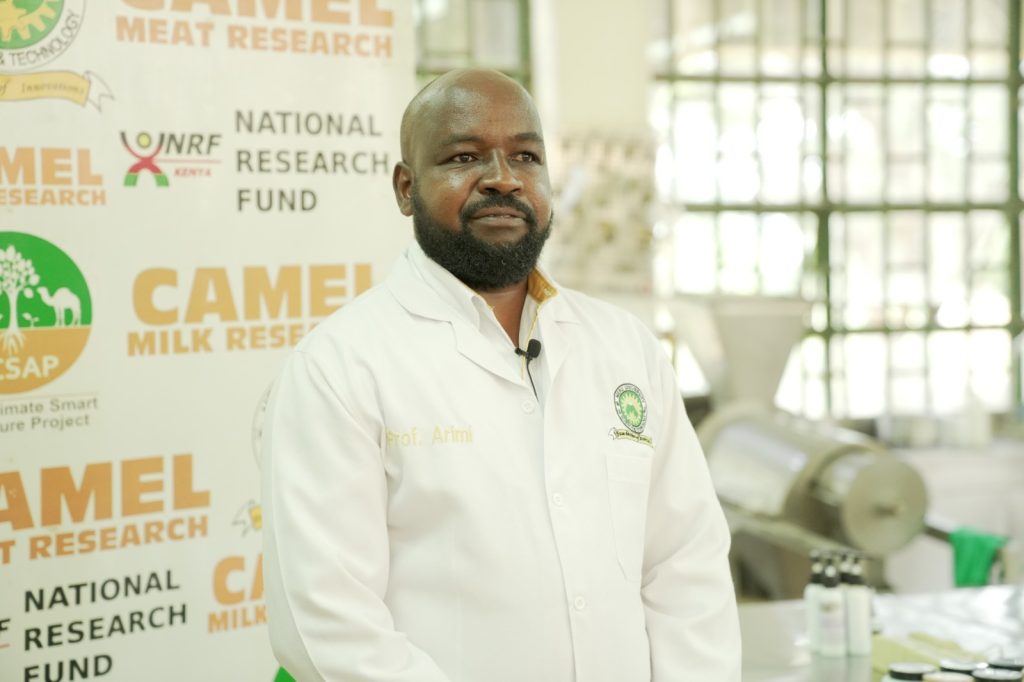
Led by Professor Joshua Arimi, the multidisciplinary project received KSh 18 million in NRF funding and brings together researchers from different institutions to explore the processing, preservation and utilisation of camel milk.
One of the key challenges addressed by the research was the difficulty of producing camel milk yoghurt with the texture and consistency expected by consumers. Unlike cow’s milk, camel milk has different protein characteristics that affect its ability to form a firm yoghurt structure. Through research on fermentation and stabilisation, the team developed methods to improve the yoghurt’s consistency.
The work has since extended to the development of a range of food and cosmetic products. These include yoghurt, low-fat milk, milk powder, butter, chocolate, ice cream and soft cheese, as well as body and face creams, lip balm, body lotion and soap.
A major milestone was reached in June 2026 when MUST unveiled Ka-Mero Camel Milk Yoghurt during its fifth International Conference. The product, developed under the leadership of Professor Arimi, represents an important step in translating research findings into an innovation with commercial potential.
The project has also contributed to research capacity development. Its achievements include supporting nine postgraduate students, comprising four doctoral and five master’s students, and training more than 25 early-career researchers. The research team has also reported two patent applications.
Beyond product development, the initiative has sought to strengthen the role of local communities in the camel milk value chain, including through engagement with women’s groups on product development and marketing.
By exploring ways to improve the processing and utilisation of camel milk, the research is creating possibilities for reducing post-harvest losses, diversifying available products and increasing the value of a resource that supports livelihoods in dryland communities.The project reflects the importance of investing in research that builds on locally available resources and responds to practical challenges in food systems and enterprise development